
Searching for a Warrant in Iowa
No Iowa site answers warrant status statewide. That answer lives at the county level. Iowa Courts Online shows the public side of Iowa District Court dockets, but live warrant status is not part of what it shows. The secure IOWA System holds that data. Only authorized criminal-justice users can query it. Before you search, collect the full legal name, date of birth, known county, and any citation or case number, since common Iowa names overlap. A matching docket does not establish an active warrant. City ordinance and municipal-infraction cases run through Iowa District Court, not a separate municipal court. Where arrest is a concern, a lawyer can advise on inquiries, bond, a motion, or surrender.
- Search the public Iowa Courts Online docket by a supported name, birth-date, case-ID, or citation method. Review public events and identify the county, but do not treat an empty result as a warrant clearance.
- Contact the county Clerk of Court to ask about the Iowa case docket, hearing, balance, filings, and any information that is withheld from public view. The Iowa Judicial Branch court directory routes to county court offices.
- Open the Iowa county directory and reach the sheriff or issuing agency for current service status, bond, and surrender instructions. A public Iowa county list may cover only a limited date range or set of agencies.
- For a city citation, ask the originating police department or prosecutor to identify the case. It still goes through Iowa District Court; request existing releasable records from the proper custodian under chapter 22.
- For a traffic-fine suspension, use Iowa DOT separately. For federal cases, use PACER and the relevant federal court. Neither is a state-warrant search; ask an Iowa attorney about an uncertain case.
Iowa's Secure Warrant System
IOWA is a secure Iowa network for warrant and article inquiries. The Iowa Department of Public Safety supports it. DPS reports more than 450 law-enforcement and criminal-justice agency users but publishes no county map or warrant-category coverage list, so the figure does not prove every Iowa warrant is included. The public cannot repeat an officer's query. DPS supports criminal-information systems. It does not decide probable cause or recall an Iowa warrant. Read the DPS IOWA System description, then confirm the Iowa case with its county court and the law-enforcement agency.
Warrant Search Fields Explained
Iowa Courts Online splits lookups into separate name, birth-date, case-ID, and citation searches instead of one warrant form. The official help guide explains each field. A citation number identifies a traffic case, not a warrant. Case-ID search requires a county and case type.
| Field Label | Type | Required | Notes |
|---|---|---|---|
| Last/Firm name search | Text | Required | Enter at least two letters. Exact spelling is recommended; a percent sign works as a wildcard. |
| First name | Text | Optional | Two names can be joined with AND or OR. The help says not to put a period after a first-name initial. |
| Date of birth search | Date or text | First and last name plus exact DOB | Middle name is optional and may use a wildcard. |
| County in Case ID search | Dropdown | Required | Choose the county where the case is filed. |
| Case type in Case ID search | Dropdown | Required | Use the live application's listed values; the help does not supply a fixed list here. |
| Case ID | Text | Optional within that method | The help describes a 17-character format using uppercase letters. |
| Citation number | Text | Enter for citation query | Used to look up a traffic citation; it is not a warrant number. |
Basic docket searches in Iowa cost nothing. Some documents or enhanced searches may require a subscription or a courthouse terminal, and no current price is posted. The live interface decides which options appear. For an older Iowa case or a missing document, ask the county Clerk which search route applies.
Why Iowa Searches Miss Fresh Warrants
A fresh Iowa case can lag on the public docket. New cases may take one business day to appear. Document entry can take longer. Public cases generally reach back to 1998, and older files may need a Clerk search. A blank result can mean timing, an incomplete query, or an old record rather than no warrant. The Iowa Courts Online trial-court case-search page is the public entry point for docket searches, not a warrant-status screen.
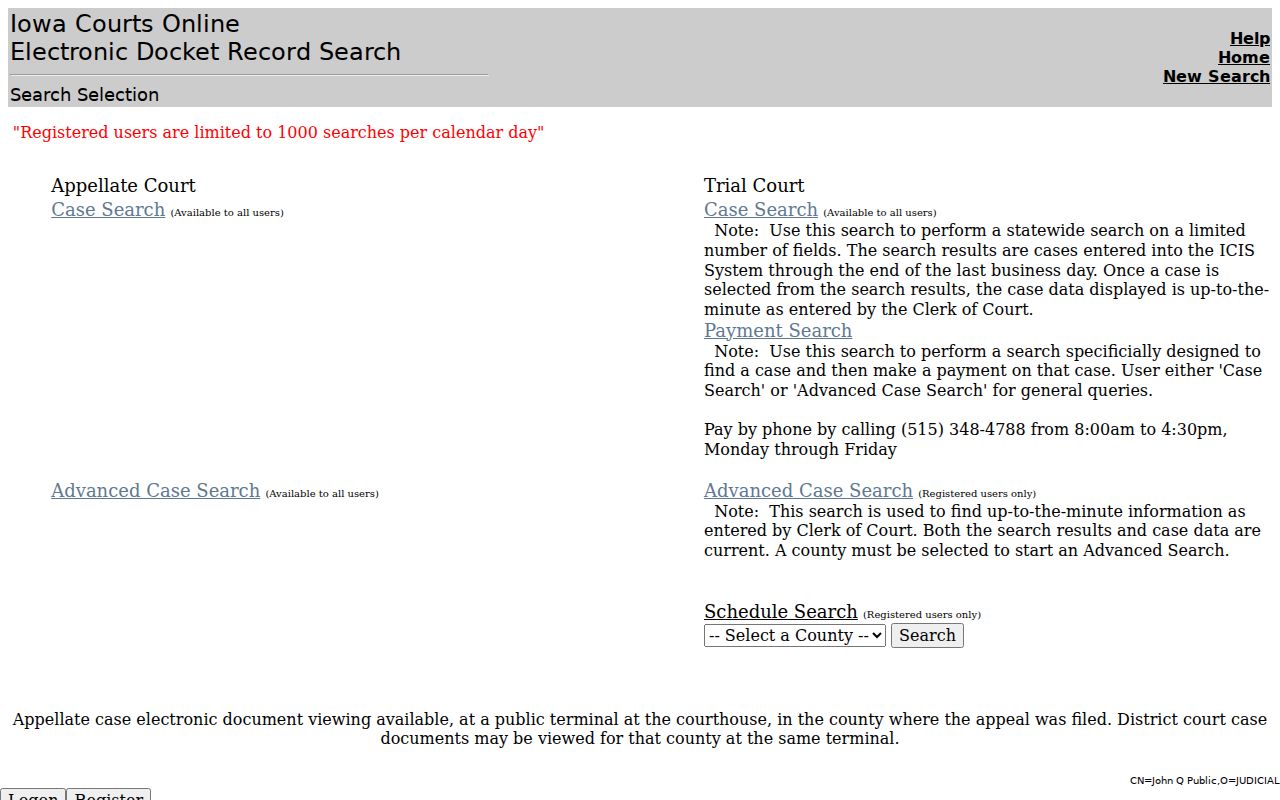
This blank interface helps locate a public case. Warrant status is a different question. The Clerk of Court and county sheriff still answer it. Under Iowa Code section 804.29, information filed to secure an arrest warrant stays confidential until arrest and return or initial appearance, unless the court orders otherwise. The Judicial Branch's restricted-document policy marks outstanding arrest or search warrants restricted pending service. Restricted does not mean expired, so confirm the specific Iowa case with its court or agency.
What a Warrant Search Shows
Iowa uses no statewide warrant-result format or unique number scheme. Iowa Courts Online shows public docket details such as case title, parties, charges, events, dispositions, and fines. A sheriff's list may add a warrant ID, date, charge, and bond type. Those fields describe one county, not all of them.
| Case title and parties | The Iowa public court docket may show a case title, party, or lawyer; this identifies a case and does not by itself confirm warrant status. |
|---|---|
| Charge and events | Iowa Courts Online can show a charge, docket event, and disposition when public. An Iowa FTA event may need clarification from the clerk. |
| Citation or case ID | These docket identifiers help locate the court file. A citation number is not a statewide warrant number. |
| Warrant identifier | Some county lists expose a local warrant or docket identifier. Research found no statewide unique warrant-number format. |
| Bond and date | An Iowa local sheriff list may give a bond amount or type and warrant issue or status date. Ask the issuing county for current terms. |
| Active status | A public Iowa docket or a local list may not be current or complete. The sheriff or issuing agency confirms operational status. |
A disposition, payment, or list change does not prove a separate Iowa warrant was recalled. The court record tells a different story. Ask the Clerk about the record and the sheriff about service and bond.
Iowa County Warrant Search Limits
County warrant pages across Iowa vary widely. Scott County's search covers active warrants issued 18 months to 7 days earlier, plus records disposed or served in the prior 30 days. Very recent and older active warrants may fall outside it. The list covers only records held by Scott County agencies, not a statewide Iowa index. The county warns that information can change. Accuracy is not guaranteed. Confirm a warrant through authorized law-enforcement personnel, it says, and never act on a listing alone. The blank Scott County warrant-search form shows its local fields. Those Iowa coverage limits should travel with any reading of the form.
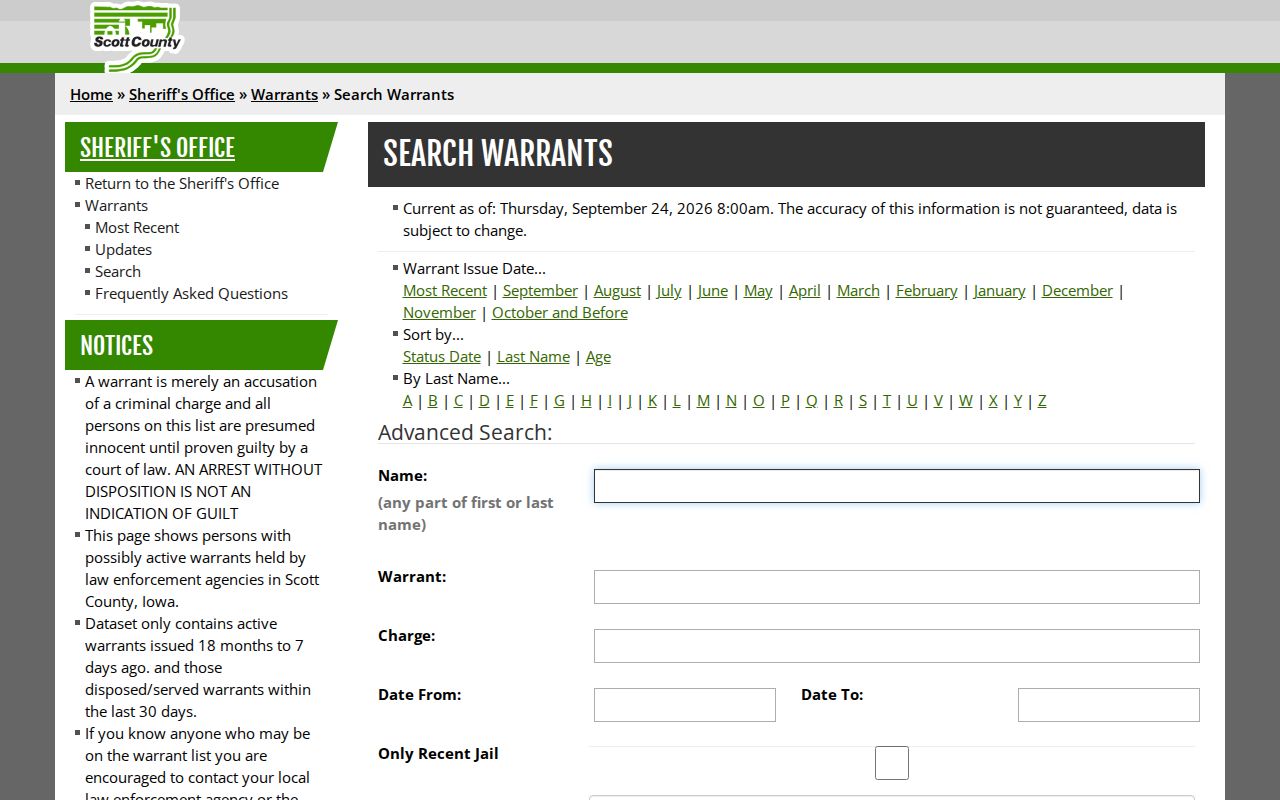
This Iowa county example shows one local interface. It is not a model for every Iowa sheriff, nor proof of statewide warrant coverage.
Where to Check Warrants in Iowa
Iowa warrant records live in separate offices. Iowa Courts Online shows the public docket. The county Clerk handles docket events and filings. The Iowa sheriff or issuing agency confirms service, bond, and surrender arrangements. City cases stay in Iowa District Court, even when police or a prosecutor can identify the citation. Iowa has no separate municipal or justice-of-the-peace warrant portal. A personal check may need both the public docket and county confirmation, and the Iowa county directory routes to local offices. Chapter 22 requests can seek existing Iowa records, subject to exemptions.
Iowa's Other Warrant Search Channels
Not every Iowa warrant search tool answers the same question. The Iowa Sex Offender Registry Most Wanted search tracks a curated set of registrants who are out of compliance and hold an active arrest warrant. It is not a general index of traffic, FTA, or criminal warrants across Iowa. You can filter it by name, city, county, or Current versus Located status. The registry's FAQ says general information updates daily, sometimes every 30 minutes on weekdays. That schedule is no promise your warrant check reflects the newest entry. A different Iowa channel is the Iowa DOT nonpayment page, which covers driver-privilege suspensions for eligible unpaid court fines. A DOT suspension is not an arrest warrant. A warrant is not a driver-record lookup either. Federal PACER records handle federal cases only, and sealed matters may stay out of public view. None of these channels replaces confirmation from the issuing Iowa county.
Request Existing Iowa Warrant Records
Want an existing Iowa warrant record rather than a search screen? Iowa Code chapter 22, the Iowa Open Records Law, gives you the right to examine and copy public records, within legal exceptions. You can ask in person, by phone, in writing, or electronically. Tell the custodian who you are asking and describe the docket, report, or record narrowly enough that staff can actually find it. The law has limits, though. It does not force a custodian to build a new warrant search, interpret a database for you, or hand over material a court rule or statute protects. Copying and staff time can bring reasonable charges. Ask for an estimate first.
For court records, the Iowa Judicial Branch lays out its route on a public-records request page. In an Iowa county case, the Clerk of Court answers questions about the docket. The sheriff or issuing agency keeps law-enforcement records and can confirm operational status. Asking one office never substitutes for asking the other. If something is denied or redacted, the response should name the Iowa rule that applies.
Note: Iowa's open-records law reaches existing releasable records; it does not create a statewide warrant lookup.
Restricted Warrants and Access Rules
Some Iowa warrant records stay closed. Iowa Code section 804.29 bars public access to information filed to secure an arrest warrant until the arrest and return, or an initial appearance, happens. The court can order otherwise. Juvenile records sit under Iowa Code section 232.147, which keeps them confidential except for statutory exceptions. Even then, a public docket may show parts of an Iowa case while withholding the warrant application and related documents entirely.
Access rules: Iowa Code section 804.29 governs arrest-warrant information, and section 232.147 protects juvenile court records. A missing online entry is not proof that no warrant exists.
A Chapter 22 request cannot override a restriction on an Iowa record. Ask the Clerk of Court whether any docket information or hearing is public. Then confirm operational status with the sheriff or issuing agency. No registry result, county list, or Iowa docket printout counts as a warrant-validity certificate.