
Inside the Iowa Most Wanted Program
Iowa's public Most Wanted page belongs to the Iowa Sex Offender Registry. Its listed cases are registrants reported as out of compliance or absconders with an active arrest warrant on file. That is a defined Registry category, not a statewide roster of every person with a court warrant. A traffic FTA, an ordinary criminal case, or a warrant for someone outside Registry obligations is not covered as a general class.
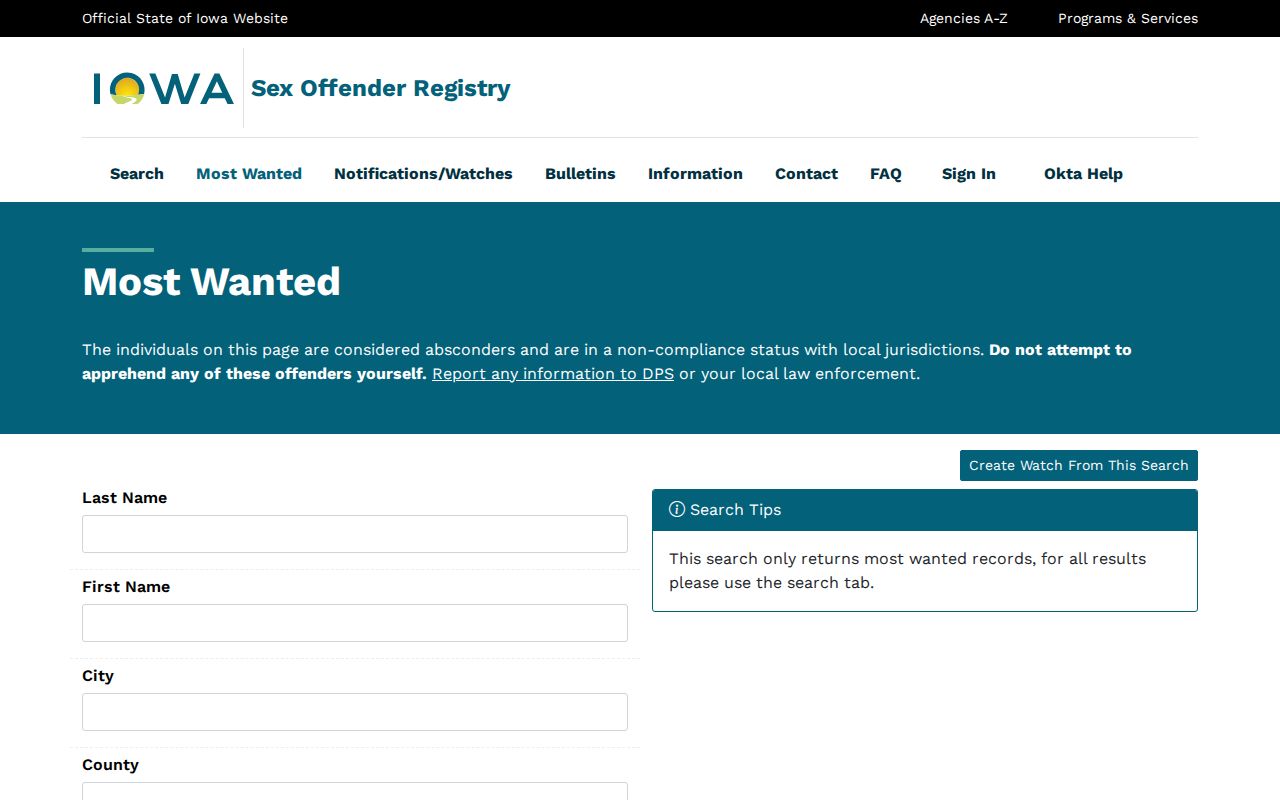
The official Iowa Registry interface lets a reader search the program by name, city, county, and the labels Current or Located. A page label describes Registry search behavior. It is not a substitute for the Iowa court's disposition or the sheriff's confirmation. Use the official interface for current information; do not republish names, images, addresses, charges, or profiles.
The image links to the Registry's blank search interface. It shows search controls only, with no result cards or person-level information.
Iowa Registry records may change. Follow the official site's instructions for its current scope, and use Iowa county court and sheriff channels for a separate warrant question. The reviewed Iowa materials do not list a general statewide reward amount or promise anonymous reporting for every tip route.
Iowa Sex Offender Registry Most Wanted
The official Registry interface for its limited absconder and noncompliance category. It is not a general Iowa warrant search.
Iowa Department of Public Safety
DPS supports the restricted IOWA System for authorized users; it is not a public Most Wanted roster.
The Registry Covers a Narrow Group
The Iowa Registry FAQ describes Most Wanted records as registrants who are not complying with registration requirements and have an active arrest warrant. The page is therefore a Registry enforcement tool, not a broad list selected from every Iowa court or law-enforcement file. It does not establish the status of unrelated warrants and should not be treated as a shortcut for checking a general criminal or traffic case.
The Iowa Registry's own wording that another search tab returns “all results” refers to results within that Registry system. It does not mean all outstanding warrants statewide. Iowa has no public statewide active-warrant index. The secure IOWA network is limited to authorized users, and Iowa Courts Online is a public docket search rather than an operational warrant feed. Keep each Iowa record scope distinct when interpreting an empty page.
The official Registry FAQ explains the Most Wanted category and gives the agency's reporting direction. Consult that source for current program wording and the relevant county court for case-specific status.
Iowa Statewide and County Most-Wanted Lists
Iowa's statewide Most Wanted page is a specific Registry program. Iowa county sheriff information is a separate layer, and each county decides what public pages or records it offers. Research reviewed here did not establish a complete county Most Wanted roster or uniform county format. The directory routes to Iowa county hubs so a reader can find local court and law-enforcement channels without assuming every sheriff publishes a list.
| Feature | Statewide List | County List |
|---|---|---|
| Source | Iowa Sex Offender Registry Most Wanted program | County sheriff or Clerk of Court channels, where available |
| Scope | Registry noncompliance / absconder category with an active warrant on file | Case and agency records vary by county; no uniform roster identified |
| General warrant coverage | No; this is a narrow Registry subset | Local search scope depends on the county page or record |
| Route | Official Registry page | Iowa County Directory |
Open the relevant Iowa county hub through the Iowa County Directory to find its official court and sheriff links. Confirm whether a local list exists and what it includes before relying on it. Iowa county search channels do not share one required format or a single statewide update rule.
County Filters Do Not Prove County Coverage
The Iowa Registry search includes a County dropdown for Iowa counties, along with text fields for first name, last name, and city. It also provides Current and Located status controls. Those controls narrow the Iowa Registry search. They do not show which county court issued a warrant, every county officer who can serve it, or whether the person's other warrants appear.
An Iowa county choice is not a warrant-system coverage map. A result is still a Registry record, and no result only means that the selected Iowa Registry search did not return a matching entry. For a court case, use the case county and its Clerk of Court. For service status, ask the sheriff or agency responsible for the order. Iowa county public lists may use different fields and date limits.
Reporting a Tip Safely
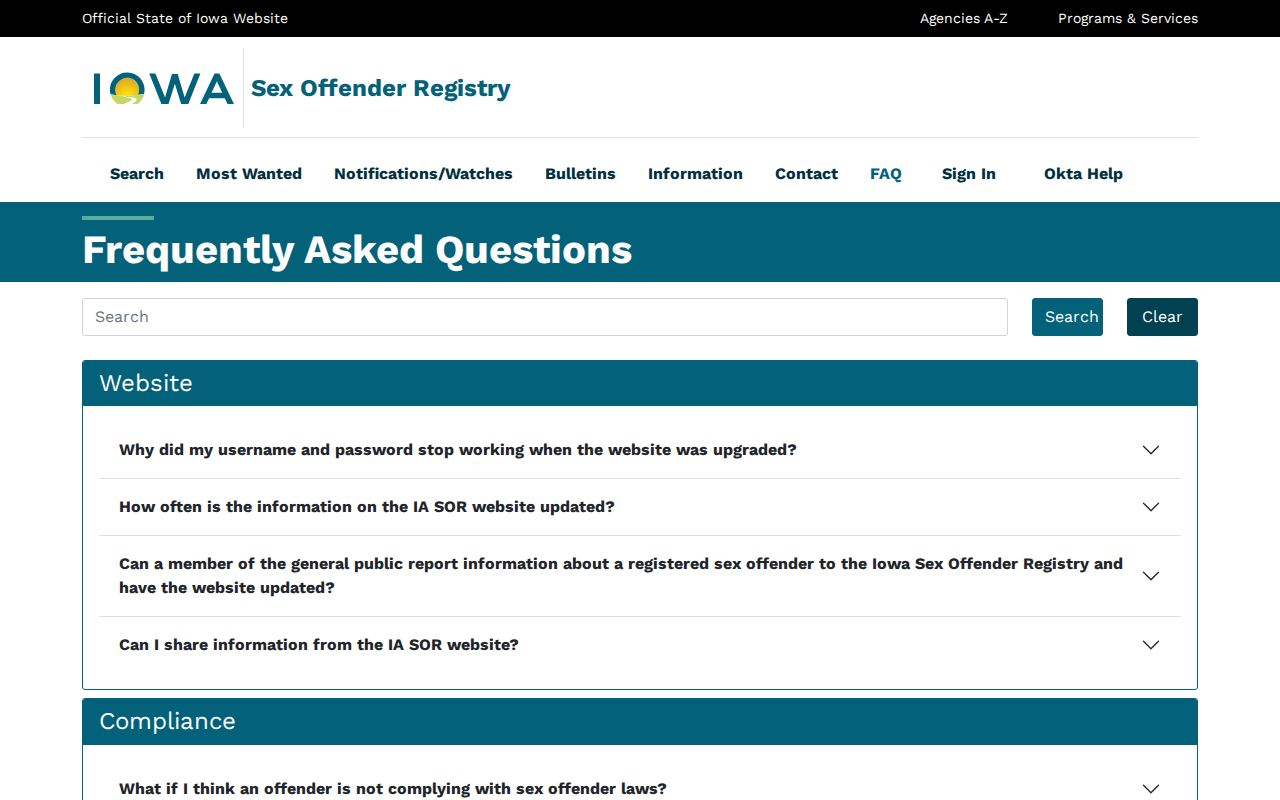
The Iowa Registry directs reports about a person shown in its Most Wanted program to Iowa DPS or local law enforcement. It warns people not to attempt an apprehension themselves. The Iowa materials reviewed do not identify a general statewide reward amount or promise that every reporting method is anonymous, so do not assume either. Follow the official Iowa Registry directions and ask the receiving agency how it handles information.
- Open the official Registry Most Wanted page or its FAQ and use the reporting route stated there.
- Give the information to Iowa DPS or local law enforcement. Ask how to share details safely if you need to protect your identity.
- Do not contact, follow, confront, or try to detain the person. Let officers assess the information.
- For immediate danger or an emergency in progress, call 911.
Key point: Send a tip to the official agency and do not approach anyone; the Registry specifically warns against attempting an apprehension.
The Registry FAQ image links to its reporting and safety instructions. It contains program-level information, not a profile or a person's record.
Check that page for current instructions before passing along a tip.
Registry Labels Are Not Court Dispositions
The Iowa Registry interface separates Current and Located searches. These are Registry program filters, not a full set of Iowa court dispositions such as served, recalled, or quashed. The Iowa Registry FAQ says general information is updated daily and sometimes every 30 minutes on weekdays, excluding holidays. That is not a per-warrant refresh promise, and a displayed label is not a real-time court ruling.
If a result appears to concern you or a family member, confirm identity and current status with the Iowa county Clerk of Court and responsible law-enforcement agency. A profile can change after the page is viewed. Conversely, a person not appearing in the Iowa Registry Most Wanted search may still have an unrelated court warrant. Do not repost Registry images or personal details as a substitute for official confirmation.
How Most Wanted Differs From an Active Warrant
An Iowa warrant is a court order in a case. Iowa's Registry Most Wanted page is a narrow public program for certain registrants with an active arrest warrant on file. It does not include every active warrant, every FTA case, or every person wanted by a local agency. It also does not decide guilt. An Iowa court docket and the issuing agency's current service record answer different questions than a Registry search.
Not appearing in Iowa's Most Wanted program does not establish that no warrant exists. An Iowa resident checking a personal case can start with Iowa warrant lookup options, then contact the Clerk of Court and sheriff for the county where the case arose through the county directory. For a Registry concern, use the Iowa Registry's own official contact instructions.
Iowa's Federal Fugitive Work Is Separate
The Iowa Sex Offender Registry Most Wanted search and U.S. Marshals fugitive work are different programs. Iowa has Northern and Southern federal districts. The U.S. Marshals Service in Iowa coordinates federal warrant service with local, state, and federal partners, including task-force operations. A public release may describe aggregate Iowa arrests from one operation, but those results do not make a statewide wanted roster or establish the status of a separate county warrant.
The U.S. Marshals Northern District of Iowa page describes the federal district office. Federal court matters route through the federal court and Marshals channels, while a state warrant remains with the Iowa court and county agency that hold the case.
U.S. Marshals Service, Iowa Districts
The Marshals Service works with partner agencies on federal warrants and fugitive investigations. Its federal role does not create a public Iowa county-warrant search.
When You Think You Are on a List
If you think an Iowa Registry entry refers to you or a family member, do not rely on a name match alone. Ask an Iowa attorney to help confirm identity, the issuing court, and the current warrant status. The Iowa Registry listing itself does not resolve the case. The county Clerk can explain available docket procedure, and the sheriff or responsible agency can confirm service details.
Resolution depends on the Iowa court order and case. Iowa has no public statewide warrant-clearing portal. Current Iowa law requires an individual court or law-enforcement route, so get case-specific advice before arranging an appearance or surrender.
Important: If an entry may involve you, consult an Iowa criminal-defense attorney and confirm status with the court and responsible agency before deciding what to do.
Iowa Law Bars Warrant Clinics
Iowa Code section 804.32 took effect June 2, 2026. It prohibits organizing, sponsoring, hosting, funding, promoting, or participating in a warrant-resolution clinic, including a substantially equivalent event under another name. A Polk County, Iowa clinic announcement from earlier in 2026 predates the law and is not a current option. No recurring statewide amnesty program, roundup week, or public warrant-clearing counter was identified.
Iowa law describes individual routes under ordinary procedure: surrender to a peace officer or law-enforcement agency; appear at a hearing already scheduled through ordinary court process; or file an individual written or oral motion in the pending case, with notice to the prosecutor. The judge decides an Iowa motion in the usual way. The official Iowa Act sets the rule; ask the Clerk about filing procedure and an attorney about a specific case.