
Iowa Active Warrants Explained
In Iowa, an active or outstanding warrant is one the issuing court and its serving agency still treat as open. There is no general public statewide list. No single Iowa search covers every county. Each county keeps its own case file and live service status. A state court docket may show a charge or hearing, yet it is not a real-time Iowa warrant certificate. Iowa sheriff pages differ county to county. Some publish a search or list; others handle inquiries by phone or at the office. Know the difference. Finding a public case is one thing; confirming a warrant's present status in Iowa is another. A docket event can be old. A warrant may be newly issued. A local Iowa list may also omit records outside its own scope, so match what you find to the county that holds the case. Confirm an Iowa result with the Clerk of Court and the sheriff or issuing agency there. One more caution. The word "outstanding" on an Iowa page only means the court has not closed the warrant.
Iowa Has No Public Warrant List
Iowa keeps warrant data behind two doors. The Department of Public Safety's IOWA System sits on the restricted side, open only to authorized criminal-justice users. The public gets Iowa Courts Online instead. That site searches trial-court docket information. It is not a statewide Iowa warrant-status feed. Iowa publishes no public county dropdown, coverage map, active-warrant count, or full list anywhere in that public system. So no complete Iowa statewide total can be described. Comparing every Iowa county's list is equally impossible. DPS reports that more than 450 law-enforcement and criminal-justice agencies use the IOWA System. That user count does not prove every Iowa county, agency, or warrant type is included, and no public coverage matrix exists. An Iowa resident cannot run the restricted network query personally, so any result from a local list or court docket must still be matched to the issuing county's record.
How Iowa Tracks Active Warrants
Three offices split the work in Iowa. The issuing court creates the case record. The county Clerk of Court maintains the local docket. The sheriff or another peace officer in that Iowa county handles service. Iowa's secure IOWA System supports authorized law-enforcement inquiries. The state publishes no Iowa list showing which warrant records each user or county contributes. Iowa Courts Online shows the public docket instead. These sources serve different purposes in Iowa, not one synchronized statewide list. Timing matters too. An Iowa online docket can update after filing, newly opened cases may take one business day to appear, and some documents can take days. A sheriff's public list may show only the Iowa warrants within its own stated date range and agency scope, and records can be restricted before service. Note: Absence from IOWA, Iowa Courts Online, or any local Iowa list does not prove that no warrant exists.
A Local Iowa Warrant List Has Limits
Scott County, Iowa, shows why a county search must be read against its own scope statement. Its sheriff's page says it displays possibly active warrants held by law-enforcement agencies in Scott County. The window is narrow. Listed Iowa active warrants fall between 18 months and 7 days before the current date. Disposed or served warrants appear for 30 days only. That leaves out the newest warrants. Older active ones can drop from view too. The Iowa county page also warns that accuracy is not guaranteed, data can change, and an entry must be confirmed by authorized law-enforcement personnel. Treat it as a local example. Its warrant-list page is a Scott County resource, not an Iowa-wide search. A Scott County result says nothing about status in another Iowa county, and a blank result says nothing about whether a warrant exists. Use it to find the Iowa office that can confirm the case.
Note: The Iowa date window excludes some recent and older warrants, so the list cannot establish statewide absence.
Inside an Active Warrant Record
Iowa has no statewide warrant-record format. Iowa Courts Online shows court-docket fields. An Iowa sheriff's local list may show a different set of warrant details. Scott County's list is one example. It carried a warrant or docket identifier, issue or status date, charge description, bond amount and type, and age, sex, or race columns. Those labels come from one Iowa county interface, and the state uses no single warrant-number format.
| Name or party | A local list may search a name; the public court docket can show the parties and lawyer linked to a case. |
|---|---|
| Case or warrant ID | A court case ID or county warrant identifier can help locate a file. Iowa has no single public statewide warrant-number format. |
| Charge description | A sheriff list may show an offense description; a docket may show the filed charge and later case events. |
| Issue or status date | Some local lists display a warrant date or a date when its status changed. The display window may exclude older or very recent records. |
| Bond amount and type | A county entry may show a cash or surety amount or a court-appearance condition. Confirm terms with the issuing office. |
| Current status | An online label may not reflect a later service, recall, or court order. The county sheriff or issuing agency confirms current operational status. |
Iowa Courts Online can also show case title, party or lawyer, charges, docket events, outcomes, and fine status. Those fields help identify the right case. They are not warrant confirmation.
Unserved Iowa Warrants May Be Confidential
Fresh Iowa arrest-warrant details can stay off the public docket, and that is deliberate. Iowa Code section 804.29 keeps the papers filed to get an Iowa arrest warrant confidential until an officer serves the warrant and returns it, or until the defendant makes an initial appearance, unless a court orders otherwise. The Iowa Judicial Branch also tags some outstanding-warrant cases as restricted while service is pending. So an Iowa warrant search can come back empty even though an active Iowa warrant exists. The record simply has not reached the point where it opens to view.
Juvenile cases in Iowa sit under even tighter rules. Iowa Code section 232.147 guards Iowa juvenile court records, allowing only narrow statutory exceptions. Do not expect a child's case to appear in Iowa Courts Online or on an Iowa sheriff's list. Ask the Clerk of Court what public information can be shared, and ask the sheriff or issuing agency where service stands today. A Chapter 22 request will not override an Iowa sealing rule or a juvenile-record restriction.
Warrant Roundups and Most-Wanted Lists
Iowa keeps no public statewide list of every active warrant, and there is no general public roundup roster either. The one statewide feature is the Iowa Sex Offender Registry's Most Wanted search. That is an official state program anyone can search. Its reach is narrow. It covers only registrants flagged as noncompliant or as absconders with an active arrest warrant. Ordinary Iowa criminal warrants, traffic or FTA warrants, and people outside registry requirements never appear there.
Key point: The official Registry Most Wanted search is a curated subset, not a general Iowa warrant search. Report information to law enforcement; never approach or apprehend anyone.
A separate Most Wanted List reference covers these Iowa state and county programs without listing names or photos.
Iowa Registry Search Is a Narrow Subset
The Iowa Registry interface lets you search its curated Most Wanted records by last name, first name, city, county, and Current or Located status. The help text is blunt. The Iowa Most Wanted search returns only that subset, and its phrase "all results" means Registry records, not every Iowa warrant. The Registry FAQ describes Iowa program update timing. An update schedule is not a promise, though. Warrant events can move at another pace. The official Iowa Registry search interface opens with blank controls. It is a registry tool, not a statewide Iowa warrant roster.
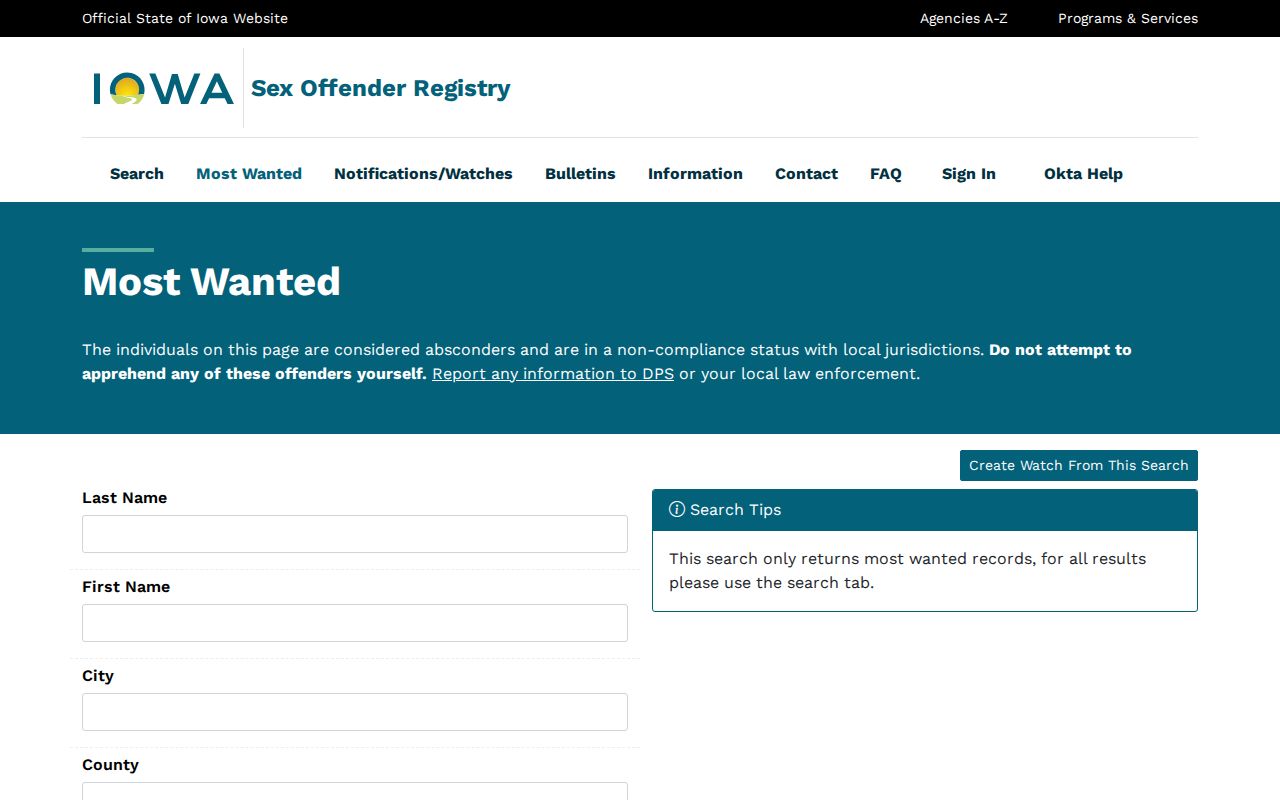
This Iowa interface shows the registry's limited search fields plainly. Its county selector still does not turn the program into a full warrant list for those Iowa counties.
Note: Iowa Registry timing applies to its own records and does not promise an update schedule for court or sheriff data.
Iowa Booking Is Not Warrant Status
An Iowa jail or arrest page answers a custody question, not a warrant question. The Polk County Sheriff's jail and arrest information page is one Iowa county example of that different record purpose. A booking may follow a warrant. It may follow a new arrest instead. Meanwhile an Iowa warrant can sit unserved and never touch a booking page. Warrants and bookings answer different questions, so these Iowa records are not substitutes. If a booking record names an Iowa case, pull the public docket. Then call the Clerk of Court and the sheriff in that county. A recent booking does not prove a warrant is still active. An empty Iowa booking page does not show the opposite either. Iowa offers no single public source that joins docket, custody, and live warrant status across every Iowa county. For state-level steps behind a name search, see Warrant Lookup. For a list that concerns your own case, ask the county office to confirm it directly.
When Your Name Is on the Warrant List
A possible Iowa warrant match needs confirming first. Check that the name and details are truly yours. An Iowa search snippet or a list alone is not enough. Call the Clerk of Court in that county. Ask about the Iowa case number, any scheduled appearance, public docket entries, and whether warrant details are restricted. Then ask the sheriff or issuing agency whether the active Iowa warrant still stands and what bond or surrender terms apply. Ask where to send a formal inquiry. An attorney can review the Iowa case and advise on appearing or surrendering. Counsel can also say whether a motion to recall or quash fits. Remember one trap. A bond or fine payment does not dispose of the underlying case or a separate FTA charge. Keep every court order and receipt. Then verify the Iowa docket and law-enforcement status yourself. Use the Iowa county directory to reach the right local Clerk of Court and sheriff.
Important: Confirm a possible match with the issuing county and consider legal advice before choosing a surrender, bond, or motion route.