
Checking for a Warrant in Iowa
No single Iowa warrant lookup covers everything. The public court docket, a county sheriff's list, and the restricted law-enforcement network each hold different pieces. Iowa Courts Online is not a live statewide warrant index. The public cannot query the IOWA System at all. County sheriff lists may cover only a stated date range or a handful of agencies. So a personal Iowa warrant check usually means calling the Clerk of Court in the case county, plus the sheriff or the agency assigned to service. An Iowa warrant can be a court order and a law-enforcement notice at the same time. Public access to those two records is different.
- Find the case county. Use a citation, notice, or case paper. If needed, search the Iowa Courts Online docket by name, then narrow by county or case type. A name match is a docket lead, not proof of warrant status.
- Read the Iowa docket. Check charges, events, fines, and dates. New cases may take one business day to appear, and some warrant information is restricted; no result does not settle the question.
- Call the Iowa county Clerk of Court. Ask what public docket entries exist, whether a hearing or motion is pending, and how to get a copy. The Clerk may not disclose sealed or unserved warrant information.
- Confirm with the Iowa sheriff or issuing agency. Ask whether the warrant remains active, which office has service responsibility, and what bond or surrender steps the court set. County lists vary, and a correction may not appear online at once.
- Request existing public records. Iowa Code chapter 22 allows requests subject to exemptions and reasonable costs. For a possible warrant, ask a lawyer about a case-specific motion, bond, or appearance.
Iowa Courts Online Can Show a Warrant Case
Iowa Courts Online searches the public side of the Iowa District Court docket. It can find a related case. It will not confirm current warrant status. Four search routes exist. Use a name, with at least two letters in the last name or firm field and a first name to narrow. Pair an exact birth date with first and last names. A case ID works with county and case type, and the Iowa help guide describes it as 17 uppercase characters. Traffic matters can be pulled by citation number, and the name search accepts a percent sign as a wildcard that broadens the Iowa docket match, not the warrant coverage.
| Search Path | What to Enter | What It Can Show |
|---|---|---|
| Name | At least two letters in last name; first name optional | Matching public case dockets, not a warrant certification |
| Date of birth | Exact date plus first and last name | Public cases tied to the entered identity details |
| Case ID | County, case type, and a case ID when known | The docket for that filed case |
| Traffic citation | The citation number | Public traffic case events and fine information |
Basic Iowa docket searching costs nothing. Bonds, returns, schedules, judgment or lien details, exhibits, documents, and enhanced queries sit behind a subscription or a courthouse terminal, with no price posted. Brand-new Iowa cases may take one business day to appear, and document entry can run longer. If a filing is missing, ask the county Clerk.
Inside the Iowa Statewide Warrant System
IOWA stands for Iowa On-line Warrants and Articles Criminal Justice Information Network, a secure network. The Iowa Department of Public Safety limits it to authorized Iowa criminal-justice agencies, with support from DPS Administrative Services and CJIS ACT staff. DPS reports more than 450 Iowa agency users. No county participation list exists. The public page covers training, certification, and audits. It offers no name-search form and no login. Iowa courts issue the warrants themselves. Authorized officers query IOWA and its connected networks, the Clerk of Court keeps the docket, and the sheriff or assigned agency handles service. DPS says IOWA connects with NCIC and other systems. Public material also gives no warrant-category coverage table, no entry rules, and no update timing by warrant type. Iowa Code section 804.4 permits statewide arrest-warrant service. See the Iowa warrant system overview for how these channels differ. Iowa also moved search-warrant applications online, with a four-county pilot in 2020 and statewide rollout in 2022. The Iowa Judicial Branch account describes chapter 808 applications, not a public arrest-warrant search.
How Iowa Warrants Move Beyond the County Line
An Iowa warrant can travel. One issued in a single Iowa county may matter far beyond the county line. The public sees no officer queries or index entries. Iowa DPS says IOWA connects with NCIC and other systems, without publishing which agencies enter each warrant type or how fast entries update. Officers may use it for authorized criminal-justice work only. It is not a public Iowa warrant lookup. The DPS description of the IOWA System explains its authorized, nonpublic access rather than any county-by-county warrant feed.
Iowa Code section 804.4 lets a peace officer serve an arrest warrant anywhere in Iowa. Statewide service is not a national database entry. For one specific Iowa case, confirm the status yourself. The Clerk of Court and the sheriff in the Iowa county tied to the case are the offices to call.
Iowa Warrant Types
Iowa warrants do different legal jobs. An arrest warrant under chapter 804 follows a criminal complaint and a probable-cause review. Miss a required traffic appearance willfully, and chapter 805 makes it a separate offense with an FTA arrest warrant. Search warrants authorize searches under chapter 808. Federal cases and Iowa juvenile matters follow separate rules. People often say "bench warrant" for a court-ordered arrest after a missed appearance or a failure to comply, but the order itself and the case control what applies.
| Warrant Type | How It Arises | Who Issues It |
|---|---|---|
| Arrest warrant | Complaint and probable-cause review in a criminal case | Iowa District Court judicial officer |
| FTA arrest warrant | Willful failure to appear as directed by a citation | Court under Iowa Code section 805.5 |
| Search warrant | Application to search named property or a place | Court under chapter 808 |
| Federal arrest warrant | Federal criminal process | U.S. District Court, separate from Iowa state court |
Section 805.5 calls the Iowa traffic process an arrest warrant for failure to appear, not a general "capias pro fine." A civil balance alone proves no warrant. A support order or a DOT suspension does not either.
Iowa City Warrants Remain District Court Matters
Iowa unified its trial courts in the 1973 Unified Trial Court Act. The sweep was huge. The Iowa Courts history of the 1973 Unified Trial Court Act records the end of more than 500 justice-of-the-peace courts, 899 mayor's courts, 14 municipal courts, and 34 police courts. Iowa District Court now hears city-ordinance and municipal-infraction cases filed in the Iowa county where the docket sits. Iowa has one unified trial-court system. No present-day city court layer carries its own warrant portal, and the Iowa Judicial Branch explains judicial assignments within District Court.
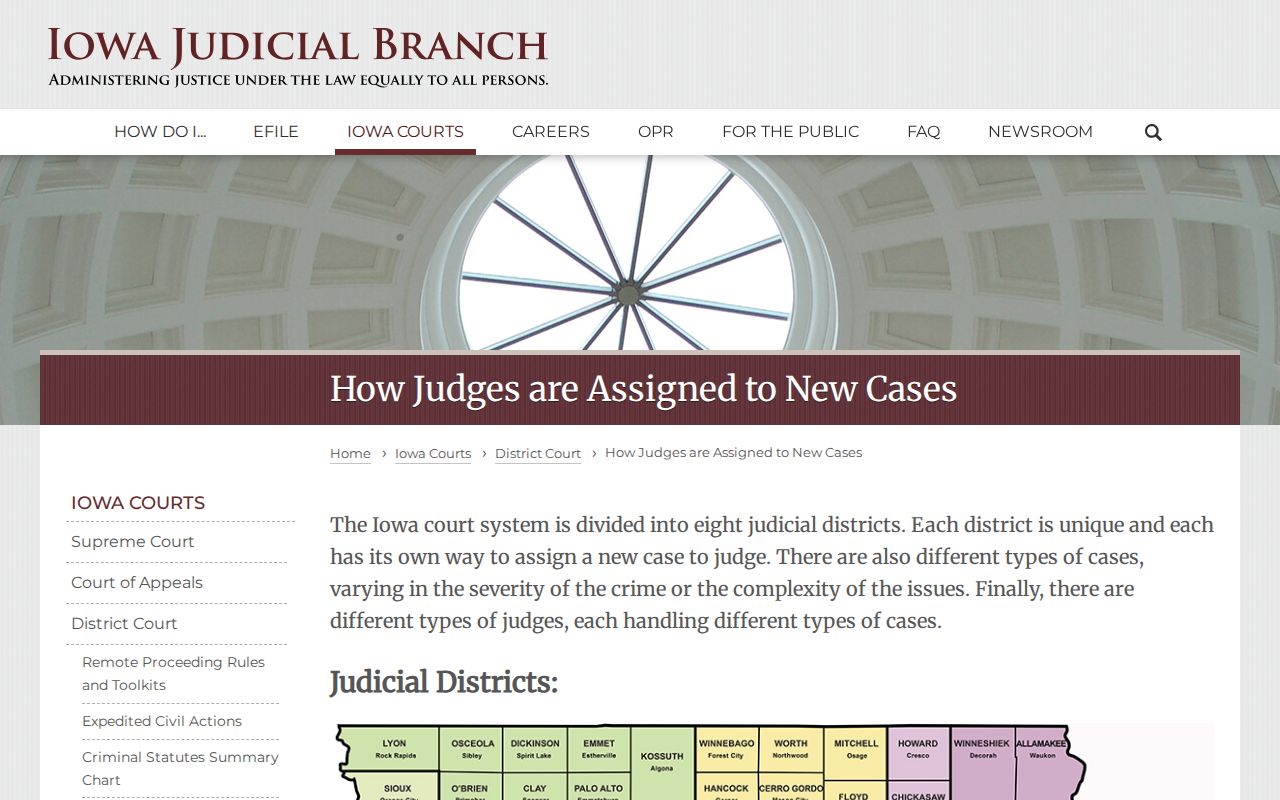
Iowa assigns warrant work by judge type, not by city. District judges, district associate judges, and judicial magistrates each handle different duties inside one district court system. A citation may start in Iowa City, but the county Clerk and the sheriff field the warrant questions.
Inside an Iowa Warrant Record
Iowa publishes no statewide warrant-record format. A sheriff's lookup may show a warrant or docket ID, the charge, bond type, date, and status. Iowa Courts Online adds public case details, events, dispositions, and amounts owed. Treat them as separate views. Before trusting a result as current, check the Iowa court and the county.
| Warrant or Case ID | A case or docket identifier may be shown; Iowa has no statewide public warrant-number format. |
|---|---|
| Party | The court docket may show a party name and, in some query paths, date-of-birth matching. |
| Charge | A public docket or local sheriff interface may describe the offense connected to the case. |
| Issuing Court | The Iowa District Court in the county where the case was filed controls the order. |
| Bond | The court sets the case-specific release terms; an online field is not a promise of current terms. |
| Status | Service, return, recall, or other court action should be confirmed with the Clerk and responsible agency. |
A case number is not an Iowa statewide warrant code. Ask the Iowa Clerk which docket event matters, and ask the sheriff or issuing agency whether the warrant is still active.
Iowa Warrant Lists Vary by County
Public warrant lists look different across Iowa's 99 counties. Some sheriffs post a searchable roster. Others send you to the phone, the counter, the docket, or an Iowa Code chapter 22 request. Each list sets its own date range and coverage, so one Iowa county's method is never a safe statewide assumption. The Scott County Sheriff's interface shows how local the scope can get. It covers active warrants issued 18 months to 7 days earlier, plus served or disposed records from the prior 30 days. You can search by name, warrant, charge, date range, a recent-jail option, status, and sort order. Even so, it is one county's collection. An officer must confirm current validity. Use a county list only when its stated scope fits your case. Otherwise ask the Clerk and sheriff in the filing county to check the file and the service status.
Why a Missing Iowa Warrant Result Is Not Clearance
A blank Iowa search result is not clearance. The record may sit outside the search's scope. It may not be on the public docket yet, or it may be legally restricted. New Iowa cases can take one business day to appear. Section 804.29 adds another layer: arrest-warrant application information may stay confidential until an officer makes the arrest and warrant return, or the defendant makes an initial appearance, unless the court orders otherwise. Sheriff lists also carry date or agency limits. Before relying on a quiet result, call the office that would hold the file.
No public result is not a warrant-status decision. Confirm a specific case with the Iowa county Clerk of Court and the sheriff or agency responsible for service. Ask whether the case is public and whether a separate court action is pending.
Give the Clerk any known court or citation details for a family member's case. A case number, county, or birth date can separate people with similar names.
Iowa Warrant Records and Public Access
Iowa Code chapter 22 opens most government records, with exceptions. You may ask in person, by phone, in writing, or electronically. Name the custodian and the existing record you want. Copying or staff costs may apply. A request cannot force a new warrant report or override a court restriction.
Key Rules:
Iowa Code sections 22.2-22.4 allow examination and copying of public records, set request methods, and permit reasonable charges.
Iowa Code section 804.29 keeps arrest-warrant application information confidential until arrest and return or an initial appearance, unless otherwise ordered.
Iowa Code section 808.13 seals search-warrant application material through execution and return.
Iowa Code section 232.147 protects juvenile court records subject to listed exceptions.
Iowa does withhold some records. Ask the custodian which rule applies. An arrest warrant and its arrest report may be treated differently, and the county Clerk can route your request to the right Iowa office.
How to Resolve an Iowa Warrant
There is no statewide clearing counter or universal recall form in Iowa. Every warrant turns on its own case. Start with the court and agency named on the case. Paying the original traffic fine does not prove that a separate Iowa Code section 805.5 FTA warrant was recalled.
- Identify the case. Use the Iowa docket, citation, or notice to find the county and case number. Ask the Clerk whether a date or motion is pending.
- Confirm status. Contact the assigned Iowa sheriff or agency. Ask which court issued the warrant, whether bond is allowed, and where to report or post it.
- Ask about court steps. An Iowa judge may require an appearance or consider an individual motion to recall or quash. Notice and filing steps vary; a lawyer can explain the case-specific route.
- Keep proof. Save orders and receipts, then check with the Clerk and service agency. A payment or list update alone does not prove the warrant is cleared.
An active Iowa warrant travels. It can be served anywhere in the state. Get legal advice before acting on a felony, probation, sealed filing, multiple Iowa counties, or a federal case. Some after-hours bond schedules have limited scope and set no guaranteed release terms on a particular warrant.
Iowa's 2026 Law Bars Warrant Clinics
Iowa closed the clinic route. Effective June 2, 2026, Iowa Code section 804.32 bars arranging, sponsoring, hosting, funding, promoting, or taking part in warrant-resolution clinics, including substantially similar events under another name. The enacted law keeps the individual paths open. You can still surrender to an officer, attend a previously scheduled hearing, or file a motion with notice to the prosecutor. The Iowa judge decides each case. A Polk County event announced before enactment is not a current statewide route.
Iowa Traffic Fines and Warrants Differ
One traffic citation can trigger two separate Iowa consequences. Failing to appear willfully may be charged as a simple misdemeanor under Iowa Code section 805.5. An arrest warrant can follow that offense. Section 321.210A works differently. It lets Iowa DOT suspend driving privileges for qualifying unpaid fines after the required notice and reporting steps, and that suspension is not a warrant. Some eligible Iowa suspensions allow a county-attorney payment plan. That plan does not recall an FTA warrant.
| Court FTA Warrant | Check the case docket and confirm with the county Clerk of Court and sheriff or issuing agency. |
|---|---|
| DOT Fine Suspension | Ask the Clerk about the balance and Iowa DOT about the person's own license status. |
| Proof of Payment | DOT accepts payment evidence for an eligible suspension; the form does not recall an arrest warrant. |
The $20 Iowa DOT reinstatement fee belongs to the license process. It clears no warrant. Other suspensions may remain. See Iowa DOT's proof instructions and the Iowa traffic warrant guide for the separate court and license steps.
Iowa's Public Counts Need Context
Those counts describe Iowa's structure, not warrant volume. The state has 99 counties and eight judicial districts. It also has more than 450 reported IOWA agency users and two federal districts. DPS publishes no county participation roster. It posts no active-warrant count either. Federal figures do not measure Iowa District Court coverage. In the 2020 Census, the eight largest counties ranged from 492,401 people in Polk to 98,537 in Story. The Census Bureau county table gives context, not warrant statistics. The Judicial Branch's court-structure snapshot lists staffing counts that may change.
Iowa Warrants by County
Where does an Iowa warrant question actually get answered? At the county level. The Iowa District Court spans the whole state, yet every docket entry sits in the county where the case was filed. The county sheriff or another local agency there can tell you whether a warrant is still active and how that county handles warrant inquiries. So start from the county printed on the citation or notice, since a neighboring county's list may not carry it at all. Iowa's eight largest counties by 2020 Census population appear below, each with its county seat and a quick note on the local path to warrant records.
Polk County
Des Moines · Largest county by 2020 population; the sheriff describes in-person warrant inquiries.
Linn County
Marion (Cedar Rapids metro) · Second-largest by 2020 population; use the clerk and sheriff for case confirmation.
Scott County
Davenport · Third-largest; its public sheriff search states a limited date and record scope.
Johnson County
Iowa City · Fourth-largest; confirm the public docket and current status with local offices.
Black Hawk County
Waterloo · Fifth-largest; the county court and sheriff are the local confirmation route.
Woodbury County
Sioux City · Sixth-largest; county warrants remain separate from federal court matters.
Dallas County
Adel · Seventh-largest; check the county docket and sheriff for a specific case.
Story County
Nevada · Eighth-largest; use the county court and sheriff to verify a warrant.
The full Iowa directory of all 99 counties links to the warrant records site for any county tied to a case.